How a Medieval Castle Was Built: Beaumaris, 1295
Watch on YouTube · Subscribe to Crest & Co.
Key facts
- How long: work began in summer 1295, stopped in 1300, resumed in 1306 and petered out around 1330. It was never finished.
- Workforce: in the first summer, around 1,800 labourers, 450 masons and 375 quarrymen.
- Materials: local limestone, sandstone and green schist from within about ten miles, plus limestone shipped from Penmon; lime mortar; timber.
- Transport: 30 boats, 100 carts and 60 wagons, and a tidal dock at the foot of the castle walls.
- Cost: about £11,000 by 1300 and about £15,000 by 1330; a 1343 survey said £684 more was still needed.
The Letter
In February 1296, on the island of Anglesey, off the north coast of Wales, a master builder sat down to write a letter to the king's treasury.
His name was Master James of St George. And he needed money.
In case you should wonder, he wrote, where so much money could go in a week, we would have you know that we have needed, and shall continue to need, four hundred masons, both cutters and layers, together with two thousand less skilled workmen, one hundred carts, sixty wagons, and thirty boats bringing stone and sea coal. Two hundred quarrymen. Thirty smiths. And carpenters, for putting in the joists and floorboards.
And then, a warning. The men's pay, he wrote, has been and still is very much in arrears. They have simply nothing to live on.
That letter has survived for more than seven hundred years. And along with the royal accounts that sit beside it, it gives us one of the most detailed pictures we have of how a medieval castle was actually built.
Why Build Here?
In the late thirteenth century, King Edward the First of England set out to conquer Wales.
By 1283, he had done it. And to hold the land he had taken, he began building a chain of enormous stone castles across the north of the country. Conwy. Caernarfon. Harlech. Each one a fortress, a royal palace, and a statement of power, all at once.
But in 1294, Wales rose again. A rebellion led by Madog ap Llywelyn swept across the north. Caernarfon was attacked, and the English sheriff of Anglesey was killed.
Edward marched back into Wales with an army. By the spring of 1295 the rising had been crushed, and the king was determined that Anglesey would never slip out of his grasp again.
The island mattered. Its farmland fed North Wales, and it guarded the Menai Strait, the narrow channel of water between Anglesey and the mainland.
Edward chose a stretch of flat, marshy land on the shore of the strait. In the Norman French of Edward's court, it was beau mareys. The fair marsh.
There was already a Welsh town nearby, called Llanfaes. Its people were moved out, and resettled at a new town on the other side of the island, which became known as Newborough. On the cleared ground, a new English town would rise. And beside it, the castle.
The Master Builder
The man Edward chose to build it was the most experienced castle builder in his kingdom.
James of St George came from Savoy, in the Alps, where he had learned his craft building castles for the counts of Savoy. Edward brought him to Wales in 1278, and for nearly twenty years he had directed the king's great works.
He was paid like it. Master James received three shillings a day for life. An ordinary skilled craftsman might need a week or more to earn the same.
Beaumaris was to be his masterpiece.
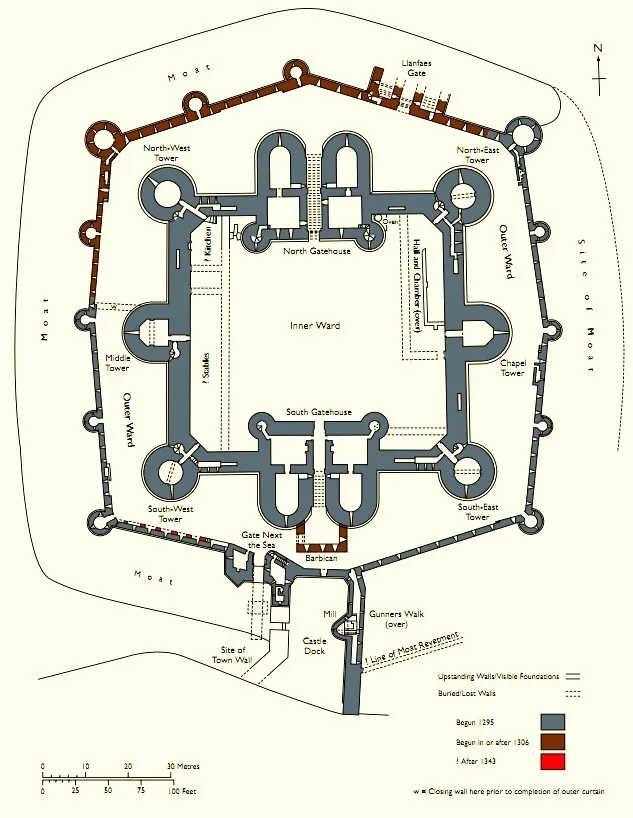
Because the site was flat and open, there was no hill or cliff to shape the design. So James drew something close to perfect symmetry. A castle built as rings, one inside the other.
At the centre, a square inner ward, surrounded by massive curtain walls, with great round towers at the corners and in the middle of the sides. Two huge gatehouses faced each other across the courtyard.
Around that, a second, lower wall, with its own towers, so that defenders on the inner walls could fire over the heads of those on the outer ones.
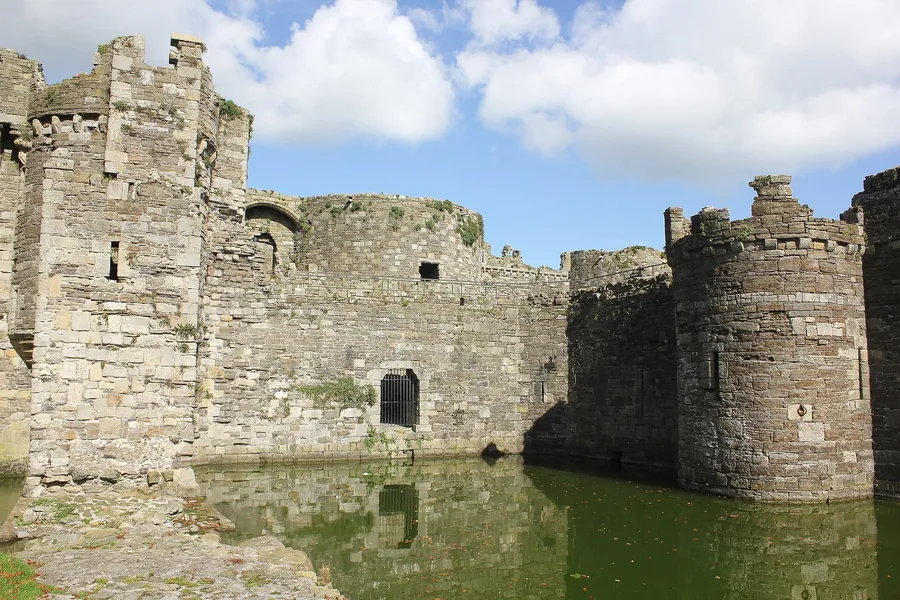
And around everything, a moat, filled from the sea.
Historians call this design concentric. Walls within walls. Any attacker who broke through the first line would find himself trapped in a narrow killing ground, facing a second wall even higher than the first.
There was one more remarkable feature. A tidal dock, built right up against the castle, so that ships could sail in on the high tide and unload their cargo at the foot of the walls.
An Army of Builders
Work began in the summer of 1295, almost as soon as the army had secured the island.
The scale of it was staggering. In that first summer, the royal accounts record an average of around eighteen hundred labourers, four hundred and fifty masons, and three hundred and seventy-five quarrymen working on the site at the same time.
They did not come from Anglesey. They came from all over England.
Royal officials sent orders to the counties to find workmen and send them to Wales. Ditch diggers came from Lincolnshire and Yorkshire. Woodcutters came from the West Midlands. Masons came from as far away as Dorset.
Many of these men were not volunteers. Medieval kings had the right to impress workers for royal building projects, and for Edward's Welsh castles, men were gathered in large numbers and sent across the country to the building sites, sometimes under escort, to stop them from slipping away on the road.
Each year, the work followed the seasons. Building was a summer trade. Mortar would not set properly in frost, so the main work ran from spring to autumn. In winter, the crowds of labourers thinned out, and those who stayed behind lived in temporary huts, put up in the middle of the half-finished castle.
Stone, Lime and Timber
A castle like Beaumaris was made from three basic materials. Stone, lime and timber.
The stone came from as close as possible, because moving it was the most expensive part of building. Most of it was quarried within about ten miles of the site: limestone, sandstone, and a green stone called schist. You can still see the mixture today, as patches of different colour in the walls.
Better quality limestone was shipped in from the quarries at Penmon, at the eastern tip of Anglesey, where the rock came right down to the sea.
But a castle wall is not solid cut stone all the way through.
Masons built two outer faces of carefully shaped stone, and filled the space between them with a core of rubble and mortar. At Beaumaris, the walls of the inner ward are several metres thick.
That mortar was made from lime. And lime was made by burning limestone in kilns at enormous heat, then mixing the result with sand and water.
This is where the sea coal in Master James's letter comes in. Coal, shipped along the coast, fed the lime kilns and the forges of the smiths, who worked constantly to sharpen and repair the masons' tools.
And then there was timber. Huge quantities of it. For scaffolding, for the wooden frames that supported arches while the mortar set, for the floors and roofs inside the towers, and for the workshops and huts across the site.
Moving Mountains
So how do you move tens of thousands of tons of material to a building site, without engines?
At Beaumaris, the answer was the sea.
Moving heavy goods over land in the Middle Ages was slow and costly. A cart could carry only so much, and roads were often little more than tracks. Water was far cheaper. A single boat could carry the load of many carts.
That is why Master James listed thirty boats in his letter. They ferried stone along the coast from the quarries, and brought coal, timber, lead and iron from further away. Many of the boats could sail right up to the castle, into the tidal dock at the foot of the walls.
From the shore and the quarries, one hundred carts and sixty wagons carried the stone the last part of the way. Wagons were the heavier vehicles, carts the lighter ones, many of them pulled by teams of oxen or horses.
And on the site itself, almost everything moved by human muscle.
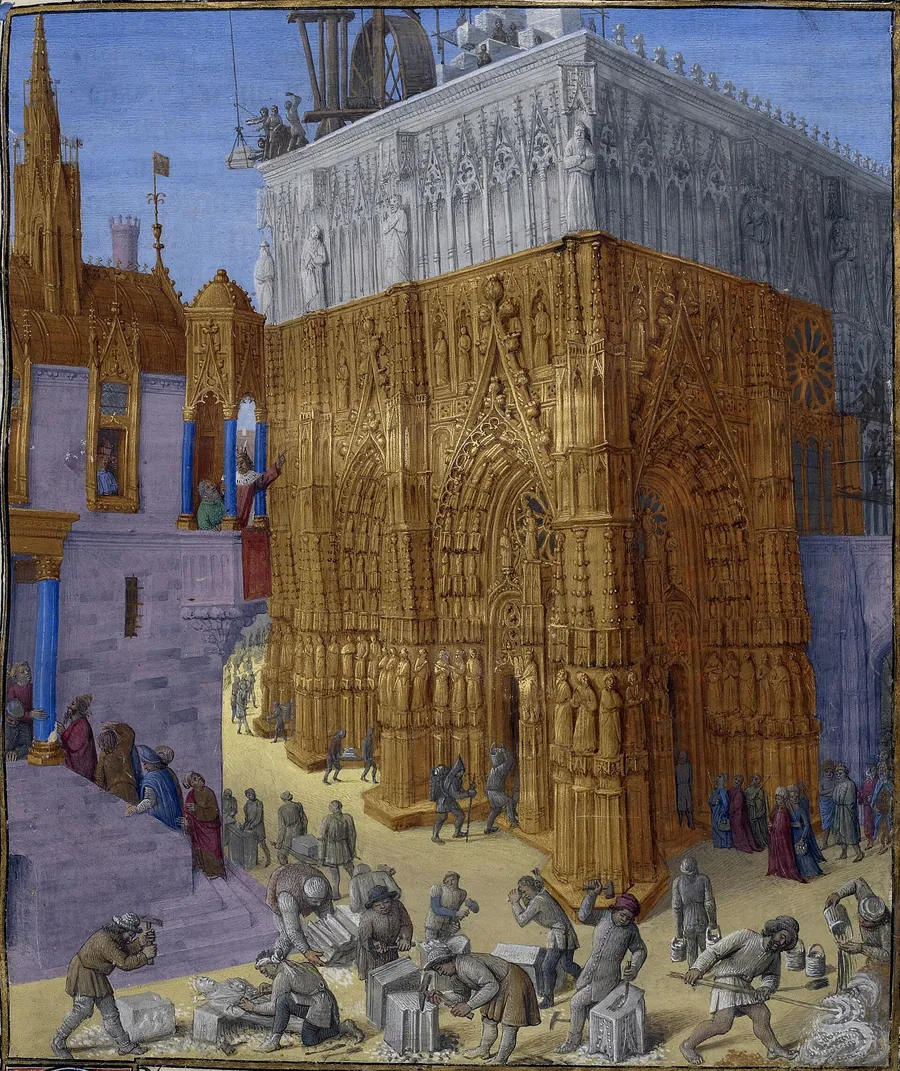
Labourers carried mortar and small stones in hods and baskets on their backs. Heavier blocks were hauled up using pulleys and winches. And for the largest loads, builders used great wooden wheels, turned by men walking inside them like a hamster in a wheel, which could lift heavy stones high onto the walls.
As the walls rose, so did the scaffolding. Builders left square holes in the masonry, called putlog holes, to hold the wooden beams that supported the working platforms. Many of those holes can still be seen in medieval walls today.
Get each new documentary first
One short email when a new Crest & Co. history film comes out. No spam, and you can unsubscribe at any time.
We only use your email to tell you about new films and the occasional Crest & Co. news. See our privacy policy.
The Workers
What was life like for the men who built Beaumaris?
For most of them, it was hard, dangerous, and badly paid.
At the top were the skilled craftsmen. Master masons, who could read the plans and set out the stonework. Hewers, who cut and shaped the stone. Layers, who set it into the walls. Carpenters and smiths.
Below them was the great mass of unskilled labour. Diggers, carriers, mortar makers. Men who cleared the ground, dug the moat, and hauled materials from dawn until dusk.
They were paid by the day, at rates of only a few pence for a labourer. Skilled masons earned more. But at Beaumaris, the problem was not just how much they were paid. It was whether they were paid at all.
The royal treasury could not keep up. The wage bill in that first summer ran to around two hundred and seventy pounds a week, an immense sum for the time. And as Edward's money ran short, the payments fell behind.
The officials on site even issued leather tokens instead of coins, as promises of payment to come.
This is what Master James was warning about when he wrote that the men had nothing to live on. Workers who were not being paid could not buy food. And men far from home, sleeping in huts on a cold, wet island, had every reason to try to leave.
Building a castle was also dangerous. Men worked high on wooden scaffolds with no safety equipment. Stones fell. Cranes failed. Walls and trenches collapsed. Medieval building accounts rarely record the injured, but injuries and deaths on large sites must have been a part of everyday life.
Racing the Clock
For a while, the work went astonishingly fast.
Within months of starting, the inner walls were rising. Master James reported real progress, and made it clear that the only thing holding the work back was money.
He also reported something else. The Welsh were still a threat. The site had to be guarded, and he urged that the castle be made defensible as quickly as possible, in case of another rising.
Within about a year, Beaumaris was already strong enough to hold.
But keeping such a vast operation running needed a constant flow of money, and the king's money was needed elsewhere.
The Money Runs Out
In the late 1290s, Edward the First turned his attention to Scotland.
The wars there swallowed the money and the men that had been pouring into Wales. In 1298, work at Beaumaris slowed. By 1300, it had stopped entirely.
By then, around eleven thousand pounds had been spent.
In 1306, a scare that the Scots might invade North Wales brought the builders back. They worked on the outer defences for a few more years, and smaller works went on until about 1330.
By then, the total cost had reached around fifteen thousand pounds. To put that in perspective, it was a sum that would have taken a skilled craftsman many thousands of years to earn.
And still, it was not finished.
The towers of the inner ward never reached their full planned height. One of the great gatehouses was built only to its first floor. In 1343, a royal survey estimated that at least six hundred and eighty-four pounds more was needed to complete the castle.
The money was never spent.
The Unfinished Castle
Today, Beaumaris stands much as the builders left it.
Low and broad, its towers stopping short of the height Master James intended. And yet, it is often described as the most technically perfect castle in Britain.
Its walls within walls. Its moat. Its tidal dock, where ships once tied up at the castle gate. The patches of grey, cream and green stone, quarried along the shore seven centuries ago.
Together with Conwy, Caernarfon and Harlech, Beaumaris is now a World Heritage Site.
It is easy to look at a castle and see only the king who ordered it. But Beaumaris was built by thousands of men whose names are mostly lost. Diggers from Lincolnshire. Masons from Dorset. Carters, quarrymen, smiths and boatmen. Men who worked through the summers far from home, often unpaid, raising one of the greatest fortresses of the Middle Ages, stone by stone.
Their work outlasted the king, his wars, and the kingdom he was trying to hold.
And thanks to one master builder's complaint about money, we still know they were there.
Sources and further reading
- Letter of Master James of St George and the Exchequer accounts, February 1296 (The National Archives)
- Cadw: Beaumaris Castle guidebook and site history
- Arnold Taylor, The King’s Works in Wales, 1277–1330
- UNESCO World Heritage: Castles and Town Walls of King Edward in Gwynedd
- Marc Morris, A Great and Terrible King: Edward I and the Forging of Britain
Header image: Beaumaris Castle from the air — Llywelyn2000, CC BY-SA 4.0 (creativecommons.org/licenses/by-sa/4.0), via Wikimedia Commons. No pictures of Beaumaris being built survive; manuscript scenes of builders come from other medieval sources.
Beaumaris was built to last seven centuries. Start a House that lasts.
Every House in history began with a name, a symbol and a motto. Build yours in the Forge and see the finished Charter free before you decide to buy.