The Black Death: The Plague That Killed Half of Medieval England
Watch on YouTube · Subscribe to Crest & Co.
Key facts
- Cause: the bacterium Yersinia pestis, spread by fleas and, in its pneumonic form, from person to person.
- Origin: ancient DNA traces the strain to burials near Lake Issyk-Kul, Kyrgyzstan, dated 1338–39.
- Arrival in England: summer 1348, through Melcombe (now part of Weymouth), Dorset.
- Death toll: an estimated one third to one half of England’s population; around half of London.
- Aftermath: the Ordinance (1349) and Statute (1351) of Labourers tried to freeze wages; resentment fed the Peasants’ Revolt of 1381.
The Year Death Arrived
England. The year is 1348.
For generations, the people of this kingdom have lived with hardship. They have survived war with France, failed harvests, and famine. Sickness is nothing new to them.
But something is coming that they have never seen before.
Across the Channel, a strange and terrible illness is moving from town to town. Those who catch it burn with fever. Painful swellings rise beneath the skin. Many are dead within days. Some, within hours.
No one knows where it came from. No one knows what causes it. And no one knows how to stop it.
Physicians search their books for answers. Priests lead their people in prayer. Families shut their doors and hope that it will pass them by.
It will not.
Within two years, villages across England will fall silent. Towns will run out of ground to bury their dead. And when the first great wave finally passes, somewhere between a third and a half of the people of England will be gone.
Those who survive will inherit a different world.
Before the Plague
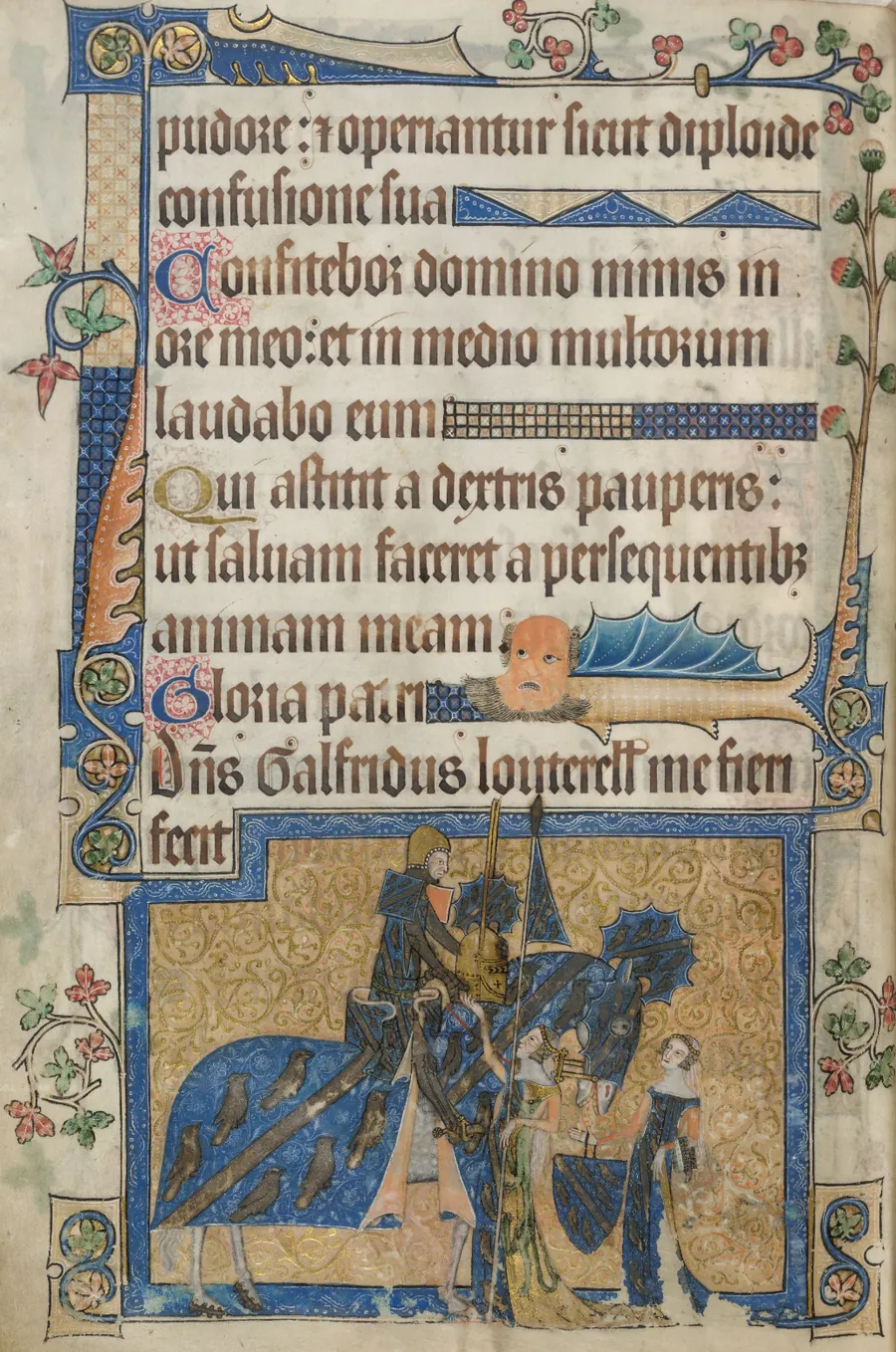
To understand what was lost, we first need to see what England looked like before the pestilence arrived.
In the early fourteenth century, this was a crowded country. Its population had grown for two hundred years, to perhaps five million people, possibly more. Most of them lived in small villages, scattered across a landscape of open fields, woodland and pasture.
Life followed the rhythm of the farming year. Ploughing in the autumn. Sowing in the spring. Harvest in the late summer, when every pair of hands was needed in the fields.
At the heart of each village stood the parish church, the largest building most people would ever enter. Its bells marked the hours of the day, the feasts of the year, and the passing of every life.
Society was ordered from top to bottom. At the summit was the king, Edward the Third. Below him, the great lords and churchmen. And beneath them, the vast majority of the population: peasants who worked the land.
Many of these peasants were not free. Villeins, or serfs, were bound to their lord's manor. They owed him labour on his fields, payments on their land, and fees when they married or died. They could not simply pack up and leave in search of a better life.
And life was already fragile. Between 1315 and 1322, years of torrential rain had ruined harvests across northern Europe. In what became known as the Great Famine, hundreds of thousands died of hunger. Cattle disease followed. Then came war with France, and the heavy taxes needed to pay for it.
England in the 1340s was a society under strain. Too many people, working too little land, for too little reward.
It was into this world that the Black Death would arrive.
Where Did It Come From?
For centuries, the origin of the Black Death was a mystery. Medieval writers spoke vaguely of a sickness rising somewhere in the East. Modern historians argued over China, India, and the steppes of Central Asia.
In 2022, scientists finally found an answer.
In the mountains of what is now Kyrgyzstan, near Lake Issyk-Kul, there are two medieval cemeteries. Archaeologists had long noticed something unusual about them. An extraordinary number of gravestones dated to the years 1338 and 1339. Some carried inscriptions recording that the dead had died of "pestilence".
Researchers extracted ancient DNA from the teeth of people buried there. Inside, they found the genetic traces of a bacterium: Yersinia pestis, the cause of plague.
More than that, the strain they found sat at a crucial point on the plague's family tree, just before it split into the branches that would later sweep across the world. In the words of the researchers, they had found the source of the Black Death.
Plague, it turns out, is an ancient disease. It lives among wild rodents, such as marmots and gerbils, and spreads among them through fleas. Usually, it stays out of sight. But when conditions change, it can leap into human populations, with devastating results.
From Central Asia, the disease moved west. The trade routes that carried silk, spices and furs across the continent connected the steppe to the cities of the Black Sea. Merchants, soldiers and their animals travelled those roads constantly. And somewhere among them, travelled the plague.
By 1346, it had reached the lands of the Golden Horde, the Mongol state that ruled the region north of the Black Sea. That year, Mongol forces were besieging Caffa, a trading port in Crimea controlled by merchants from Genoa.
A later account by an Italian writer claimed that, as plague swept through their camp, the besiegers catapulted infected corpses over the city walls. Whether that really happened is still debated. But one thing is certain.
When ships sailed out of the Black Sea, the plague sailed with them.
Death Reaches Europe
In 1347, galleys from the Black Sea arrived in the great ports of the Mediterranean. Constantinople. Then Sicily, at Messina, in the autumn of that year. Then Genoa, Venice and Marseille.
Within months, the disease had taken hold across Italy and southern France.
Medieval Europe was a world connected by water. Ships carried wine, wool, grain and cloth from port to port, and along the great rivers into the heart of the continent. Every one of those routes became a route for the plague.
The Italian writer Giovanni Boccaccio lived through the outbreak in Florence in 1348. He described how quickly it spread, how people abandoned their neighbours, and how the dead were laid in great trenches, stacked in layers like goods in the hold of a ship.
Florence may have lost half its population. In Siena, a chronicler named Agnolo di Tura wrote that he had buried five of his children with his own hands.
Through the spring and summer of 1348, the disease moved north and west. Across France. Into Spain. Along the coasts towards the English Channel.
England watched it come.
In August 1348, the Bishop of Bath and Wells ordered processions and prayers in every church in his diocese, begging God to spare the kingdom from the pestilence spreading across the sea.
But by then, it was already too late.
England, 1348
According to one English chronicle, the plague entered the kingdom through a port in Dorset called Melcombe, now part of Weymouth, in the summer of 1348.
We do not know exactly which ship brought it. We may never know. But from the south coast, the disease spread with frightening speed.
It moved along the roads and rivers. Through Dorset and Somerset. To Bristol, one of the busiest ports in the kingdom, where it struck with terrible force. By the autumn, it had reached London.
Over the following year, it reached almost every corner of England. East Anglia. The Midlands. Yorkshire. In 1349, it crossed into Wales and Ireland. By 1350, it had reached Scotland.
The records left behind tell the story in their own quiet way.
When a parish priest died, the bishop had to appoint a new one, and the appointment was written down. Before the plague, a diocese might fill a handful of these posts in a typical month. In 1349, some bishops' registers record dozens. Priests, who visited the sick and the dying, perished in enormous numbers.
The records of manors tell a similar story. When a tenant died, the lord was owed a payment, often the family's best animal. In 1349, the court rolls of manor after manor fill with the names of the dead. Holdings pass from father to son, then from son to brother, then to distant cousins, and sometimes to no one at all.
In some places, entire villages were emptied. Their fields reverted to grass. Their houses fell down. Today, they survive only as bumps and hollows in the ground, visible from the air.
At Thornton Abbey in Lincolnshire, archaeologists uncovered a single grave containing forty-eight people. Twenty-seven of them were children. Their bodies had been laid carefully, side by side, in rows. DNA from their teeth confirmed the cause of death: Yersinia pestis.
The Symptoms
What did the disease actually do to the human body?
Plague can take several forms. The most common, then as now, is bubonic plague.
It usually begins with the bite of an infected flea. The bacteria travel to the nearest lymph nodes, in the groin, the armpit or the neck. There they multiply, and the lymph nodes swell into painful lumps called buboes. Some grew as large as an egg, or even an apple.
Within days, the victim suffers high fever, chills, aching limbs and exhaustion. Without modern treatment, a large proportion of those infected died, often within a week.
If the bacteria reach the bloodstream, the result is septicaemic plague. Blood vessels are damaged. Dark patches can appear on the skin. Death can come very quickly.
And if the infection reaches the lungs, it becomes pneumonic plague. This is the most dangerous form of all. Victims cough and struggle to breathe. And crucially, pneumonic plague can pass directly from one person to another, through droplets in the air, during close contact.
For a long time, the Black Death was told as a simple story: rats carried fleas, fleas carried plague. That remains part of the picture. But historians and scientists now believe the reality was more complicated.
The disease moved so fast, and killed so many, that rats alone may not explain it. Some researchers think human fleas and lice may also have played a role. Pneumonic spread between people certainly did. The exact balance between these routes is still being studied today.
What is clear is how it felt to those who lived through it.
Medieval chroniclers described the swellings, the fever, the spitting of blood, and the speed of it all. A person could be well in the morning and dead by nightfall. Whole households fell sick together. Those who nursed the dying often followed them to the grave.
To people with no knowledge of bacteria, it seemed as though death itself had been loosed upon the world.
Get each new documentary first
One short email when a new Crest & Co. history film comes out. No spam, and you can unsubscribe at any time.
We only use your email to tell you about new films and the occasional Crest & Co. news. See our privacy policy.
The Desperate Search for a Cure
How do you fight a disease when you have no idea what causes it?
Medieval medicine was built on ancient ideas inherited from the Greek physicians Hippocrates and Galen. Health was thought to depend on a balance between four bodily fluids, called humours. Illness meant that balance had been upset.
In 1348, the King of France asked the medical faculty of the University of Paris to explain the pestilence. Their answer pointed to the heavens. A conjunction of Saturn, Jupiter and Mars, they said, had corrupted the air. That poisoned air, or miasma, rose from the earth and brought sickness to all who breathed it.
The treatments followed from the theory. Physicians bled their patients to restore balance to their humours. They lanced the buboes. They recommended sweet-smelling herbs and burning fires to purify the air. People carried posies of flowers and pouches of spices to hold beneath their noses.
None of it worked.
Many turned instead to God. If the plague was a punishment for the sins of the world, then the cure lay in repentance. Churches filled. Processions wound through the streets. People prayed to saints believed to offer protection, such as Saint Sebastian and, later, Saint Roch.
Some took repentance much further. In 1349, bands of flagellants appeared in the Low Countries and Germany. They marched from town to town, stripped to the waist, whipping themselves until they bled, in public acts of penance for the sins of humanity. A group reached London, where they performed outside St Paul's Cathedral. But the movement never took hold in England, and the Pope soon condemned it.
And in some places, fear turned into something far darker.
In parts of Europe, rumours spread that Jewish communities had caused the plague by poisoning wells. The accusation was false. Jewish people died of the plague like everyone else. But under the pressure of terror and grief, the lie spread.
In 1348 and 1349, Jewish communities in many towns, particularly in Germany and the Rhineland, were massacred. In Strasbourg, in February 1349, hundreds of Jewish people were burned to death, before the plague had even reached the city.
Pope Clement the Sixth issued orders condemning the violence, pointing out that Jews were dying of the same disease, and in places where no Jews lived at all. It was not enough to stop the killing.
England had expelled its Jewish population in 1290, so these massacres did not happen here. But they remain one of the most shameful chapters of the entire pandemic. A reminder that disasters reveal the worst in human beings, as well as the best.
Cities of the Dead
Nowhere in England felt the horror more intensely than London.
In the fourteenth century, London was the largest city in the kingdom, home to perhaps sixty or seventy thousand people. Its streets were narrow and crowded. Its houses pressed tightly together. Its markets and docks drew traders from across England and Europe.
The plague arrived in the autumn of 1348. Through the winter and into the spring of 1349, it tore through the city.
The parish churchyards could not cope. So new burial grounds were opened outside the city walls.
One was at East Smithfield, near the Tower of London. In the 1980s, archaeologists excavated part of it. They found long trenches, packed with bodies. Hundreds of men, women and children, laid side by side, sometimes stacked five deep.
What is striking is the care. Even at the height of the crisis, many of the dead had been placed respectfully, in rows, facing the same direction. Some were in coffins. This was a society under unbearable strain, still trying to bury its people with dignity.
The skeletons from East Smithfield have since become one of the most important collections in the study of the Black Death. In 2011, scientists recovered DNA from them and reconstructed the genome of the bacterium that killed them. It was the first time the full genetic code of the medieval plague had been read.
Estimates suggest that around half of London's population may have died.
Imagine what that meant in a single street. Half the neighbours gone. Shops closed because there was no one to run them. Workshops silent. Ships unloaded by strangers. Children without parents. Parents without children.
And the plague did not come only once. It returned in 1361, in an outbreak that seemed to strike the young especially hard. It returned again in 1369, and again and again over the following centuries. Every generation would learn to live with the fear of its return.
A World Turned Upside Down
When the first wave finally passed, England was a changed country.
So many people had died that there were simply not enough hands to work the land. Fields lay unploughed. Crops rotted unharvested. Lords looked out over estates with no one to farm them.
For the survivors, especially the labourers, this was something entirely new. For the first time in living memory, their work was in short supply. And they knew it.
Labourers began asking for higher wages. Tenants demanded better terms. Some simply left their manors and went in search of a lord who would pay more. Landowners, desperate for workers, competed against one another to hire them.
The government reacted quickly, and harshly.
In 1349, while the plague was still raging, Edward the Third issued the Ordinance of Labourers. Two years later, Parliament made it law in the Statute of Labourers of 1351.
These laws attempted to freeze wages at the levels paid before the plague. Every able-bodied person without land was required to work for whoever needed them, at the old rates. Workers who demanded more, or left their employment, could be punished. Employers who paid more could be fined.
The National Archives still holds records of the cases brought under these laws. Thousands of ordinary people, hauled before the courts for the crime of asking to be paid what their labour was now worth.
But the laws were fighting against reality. Over time, wages rose anyway. Many survivors ate better, lived in better houses, and had more freedom than their parents could ever have imagined.
The resentment, however, did not go away. A generation later, in 1381, it exploded into the Peasants' Revolt. Thousands of rebels marched on London, angered by a new poll tax, and by the laws that still tried to keep them in their place. Among their demands was an end to serfdom itself.
The revolt was crushed. But serfdom in England was already in decline. Within a century and a half, it had all but disappeared.
The Black Death did not cause these changes on its own. But by killing so many, it shifted the balance of power between those who owned the land and those who worked it. And once that balance had moved, it could never fully be put back.
The World That Survived
Across Europe as a whole, the Black Death probably killed somewhere between a third and a half of the population. Some historians believe the true figure was higher still. It remains one of the deadliest events in human history.
It took England more than two centuries to recover its population. Many deserted villages were never rebuilt.
But the world that emerged was not simply a smaller version of the old one.
The landscape changed. With fewer people to grow grain, many lords turned their fields over to sheep, which needed far fewer workers. Wool and cloth became the foundation of England's wealth for centuries to come.
Faith changed too. Some people turned to new forms of private devotion. Others began to question the Church that had been unable to protect them. Wealthy survivors founded chantries, paying priests to pray for their souls, and the souls of loved ones they had lost.
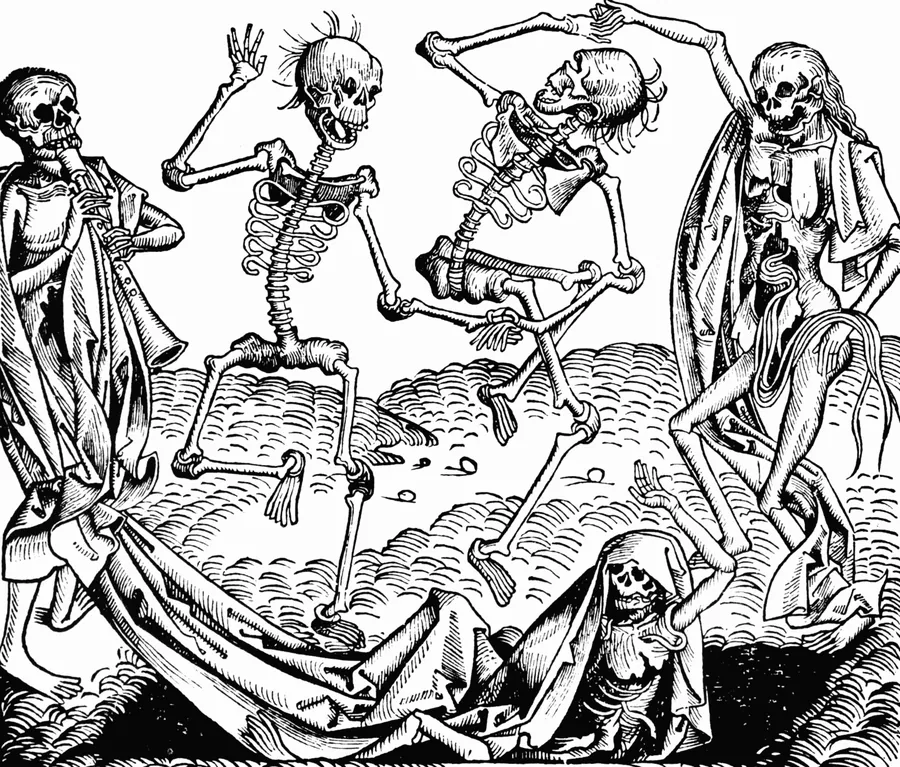
Art changed. In the years after the plague, images of death became more common across Europe. Skeletons danced with kings and peasants alike in the Dance of Death, a reminder that death came for everyone, whatever their rank. Tombs showed the dead not as they had been in life, but as decaying corpses.
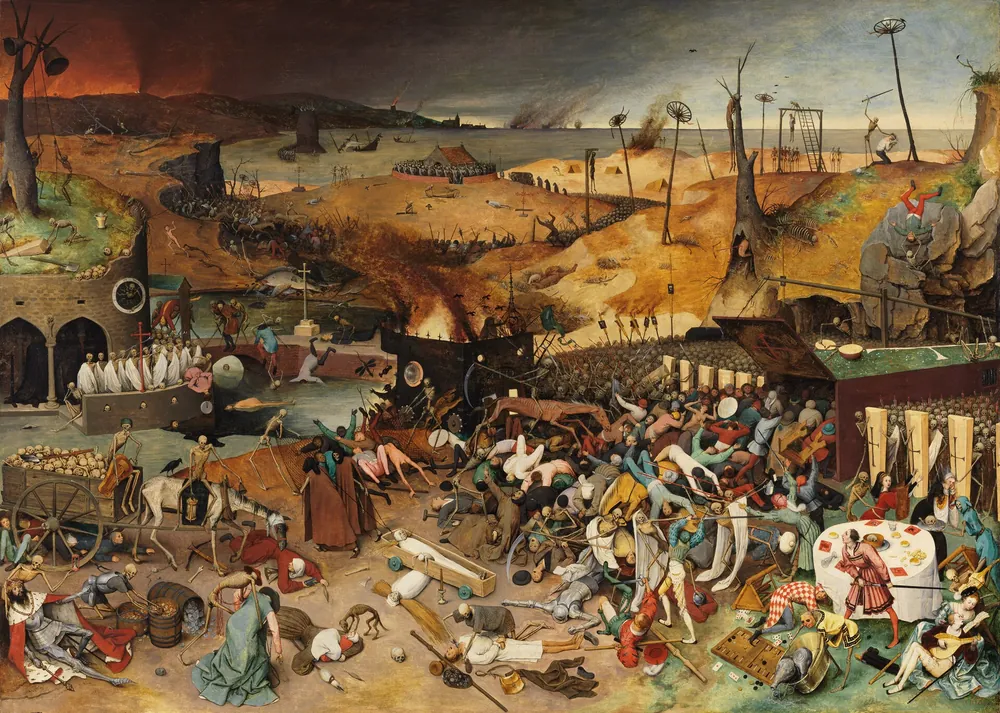
Centuries later, the painter Pieter Bruegel would capture that vision in The Triumph of Death: an army of skeletons sweeping across a burning landscape, sparing no one. He painted it in the 1560s, long after 1348. But it shows how deeply the memory of plague had shaped the European imagination.
Even medicine began, slowly, to change. In the century after the Black Death, Italian cities created permanent health boards. Venice and Ragusa introduced periods of isolation for arriving ships and travellers, eventually fixed at forty days. The Italian word for forty, quaranta, gave us the word we still use today: quarantine.
And the plague has not entirely disappeared. Yersinia pestis still exists in wild animal populations in parts of the world, including the western United States, Central Asia and Africa. Cases still occur. The difference is that today, if it is caught early, it can be treated with antibiotics.
Modern science has also allowed us to return to the dead of 1348 and ask them questions no one could have asked before. The children of Thornton Abbey. The Londoners of East Smithfield. The traders and herders buried beside Lake Issyk-Kul. Their remains have told us where the plague began, how it spread, and what it did.
Seven centuries later, we still live in the world they left behind. In the shape of our fields and villages. In our language. In our institutions. And in the knowledge, learned again in our own time, of how quickly a single disease can change everything.
The people of 1348 did not understand what was happening to them. They had no microscopes, no antibiotics, and no idea of bacteria.
But they buried their dead. They worked their fields. They rebuilt their towns. They demanded better lives.
And they survived.
Sources and further reading
- Spyrou, M. A. et al. (2022), “The source of the Black Death in fourteenth-century central Eurasia”, Nature
- London Museum: The Great Pestilence in London
- The National Archives: Plague, and the Statute of Labourers 1351
- English Heritage: Thornton Abbey and the Black Death
- United States Holocaust Memorial Museum: the persecution of Jewish communities during the Black Death
- CDC: Plague (Yersinia pestis) transmission
Header image: burial of plague victims at Tournai, 1349 — chronicle of Gilles Li Muisis, Pierart dou Tielt. Public domain. Several images on this page were made after 1348 and are used to illustrate medieval life and the memory of plague.
The people of 1348 left their names in the records. What will your House leave?
Every House in history began with a name, a symbol and a motto. Build yours in the Forge and see the finished Charter free before you decide to buy.